When AI Describes Your Company, What Does It Say?
Not long ago, researching a company followed a fairly predictable path: A potential customer might search Google, browse a few pages of your website, compare you with a competitor, and perhaps read a handful of reviews before deciding whether to reach out.
That journey is already beginning to change.
Increasingly, buyers are asking conversational questions before they ever visit a company's website. They want to know what an organization does, who it's best suited for, how it compares to competitors, or whether it's worth considering at all. Instead of being pulled from a single webpage, the answers are synthesized from information gathered across the web.
That shift doesn't change the fundamentals of marketing, but it does change how those fundamentals are experienced. Visibility is no longer only about whether your business can be found. It's also about whether your business can be accurately understood.
Understanding Is Built Over Time
Every organization leaves behind a digital footprint. Your website is part of it, but so are customer reviews, articles, business profiles, speaking engagements, thought leadership, partner pages, social content, and industry mentions. Individually, each source tells only part of the story. Together, they create a broader picture of your organization.
When someone asks an AI platform to describe your business, compare it to competitors, or recommend solutions, that broader picture becomes the foundation for the response.
The clearer and more consistent those signals are, the easier your organization is to understand. When they conflict—or simply fail to reinforce one another—the resulting description often reflects that uncertainty.
Visibility Doesn't Always Mean Clarity
One of the more interesting aspects of this shift is that visibility and understanding aren't necessarily the same thing.
An organization may have strong search rankings and a steady stream of website traffic while still being described in generic terms. Another may publish regularly but struggle to communicate what makes it meaningfully different from competitors. In both cases, the issue is rarely a lack of content, but a lack of clarity.
Strong positioning has always helped customers make sense of a business. Increasingly, it also helps AI systems do the same.
That doesn't require a new discipline as much as it reinforces existing ones. Clear messaging, thoughtful brand strategy, original insights, and consistent communication have always been valuable marketing assets. They're now influencing another audience: the systems that summarize, compare, and recommend businesses before a buyer ever lands on your website.
A Useful Way to Evaluate Your Brand
One unexpected benefit of conversational AI is that it makes ambiguity easier to spot.
Asking an AI platform to describe your company often reveals where your positioning is clear, where it's incomplete, and where it begins to blur into the rest of your market. Does it accurately explain what your business does? Can it articulate what makes you different? Does it recognize genuine expertise, or does it default to broad marketing language that could apply to almost anyone?
Those observations provide a useful starting point because they're less about technology than they are about communication. They highlight whether your digital presence consistently reinforces the story you've been working to tell.
That perspective became the foundation for my AI Visibility Assessment, which evaluates how clearly an organization is understood across areas like business understanding, authority, differentiation, competitive positioning, and recommendation potential.
One of the first deliverables is an executive scorecard that brings those observations together into a single snapshot.
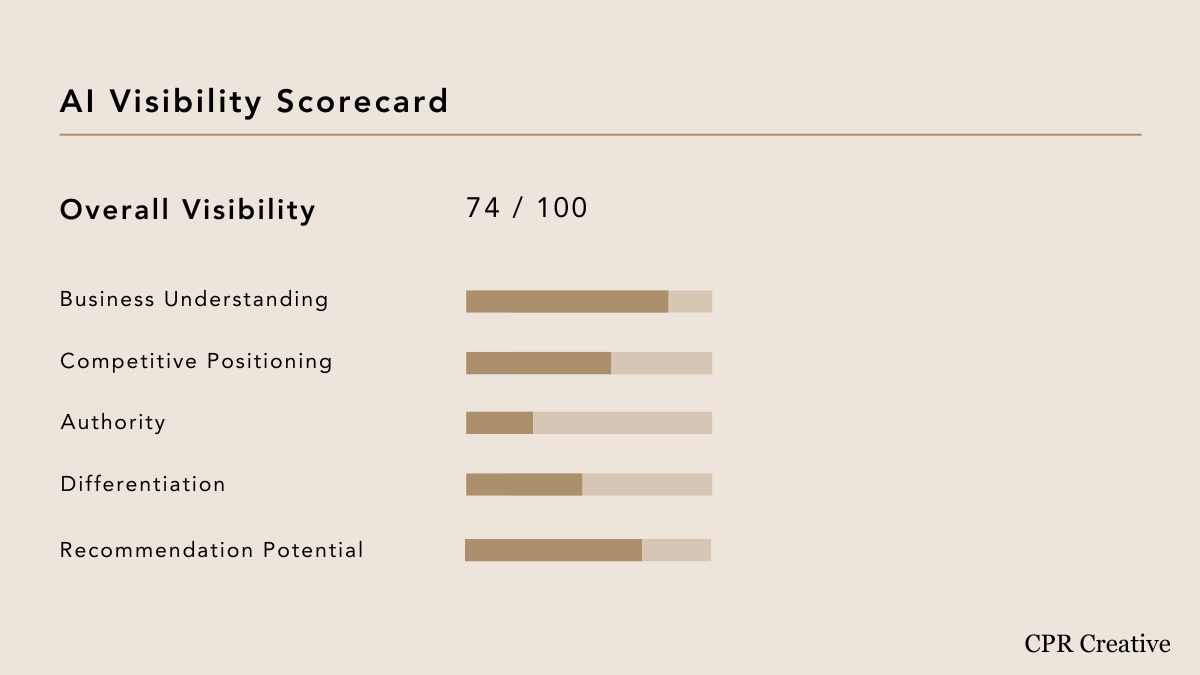
The score itself isn't the objective—it’s simply a way to identify where your digital presence is already working well, where it may be sending mixed signals, and where greater clarity could strengthen how your organization is understood.
The Opportunity Ahead
Marketing has always been about helping people understand why your organization exists, who it serves, and why it matters. Those objectives haven't changed. What's changing is the number of places where that understanding is formed.
As conversational search becomes a more common part of the buying journey, organizations have an opportunity to evaluate their digital presence from a different perspective—not just through rankings or traffic, but through clarity, consistency, and differentiation.
Because before a business can be recommended, it first has to be understood.