Fractional CMO vs. Full-Time CMO: Which Is Right for Your Business?
Both provide executive-level marketing, but they’re designed for very different stages of growth.
Hiring marketing leadership is a major decision for any growing business. At some point, founders and executives often realize that marketing has become too important to manage on the side. Growth requires strategy, accountability, and leadership—not just execution.
The question is whether your business needs a full-time Chief Marketing Officer or if a fractional CMO can provide the expertise and guidance you're looking for at a lower level of commitment. The answer depends on your goals, growth stage, budget, and internal resources.
This guide breaks down the differences, costs, benefits, and considerations to help you determine which option is right for your business.
What Is a Fractional CMO?
A fractional CMO is an experienced marketing executive who works with a company on a part-time, contract, or retainer basis.
Rather than joining the organization as a full-time employee, they provide strategic leadership for a portion of the week or month, helping businesses access executive-level expertise without the cost of a permanent hire.
Typical responsibilities include:
Marketing strategy
Positioning and messaging
Demand generation planning
Team leadership
Sales and marketing alignment
KPI development and reporting
Vendor and agency management
Marketing infrastructure and process improvement
Fractional CMOs are most commonly engaged by startups, small businesses, and mid-sized organizations that need leadership but don't yet require a full-time executive.
What Is a Full-Time CMO?
A full-time CMO is a permanent executive responsible for leading the organization's marketing function. In addition to developing strategy, full-time CMOs typically manage teams, budgets, hiring, cross-functional initiatives, and long-term growth planning.
Their responsibilities often include:
Executive leadership
Team management
Hiring and organizational development
Budget ownership
Strategic planning
Revenue accountability
Board and investor communications
Cross-functional leadership
A full-time CMO becomes a dedicated member of the leadership team and is responsible for the long-term success of the marketing organization.
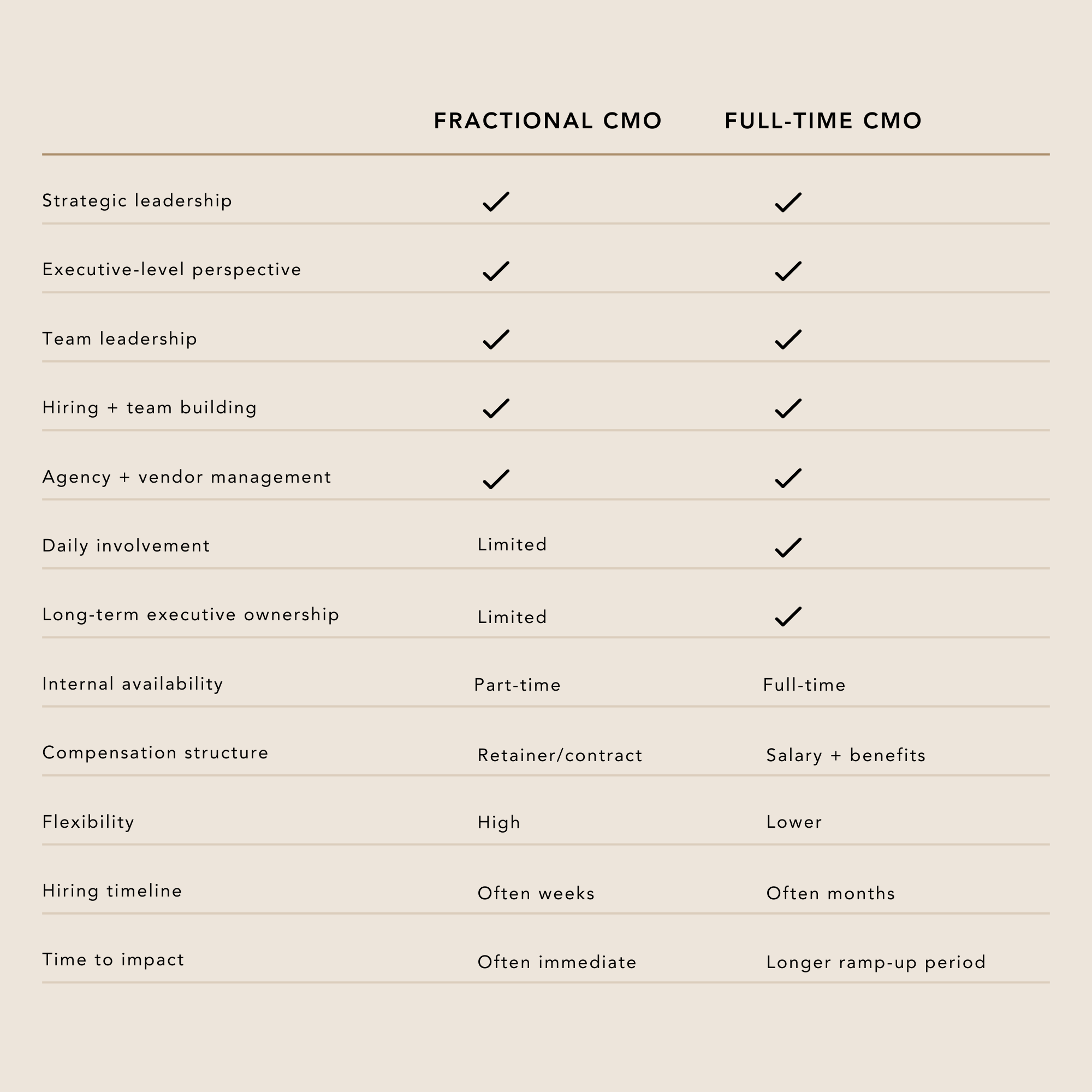
When a Fractional CMO Makes Sense
A fractional CMO is often the right fit for businesses that need executive-level marketing leadership but don't require a full-time executive.
Many growing companies find themselves caught in the middle. Marketing has become too important to manage on the side, but there isn't enough complexity, budget, or day-to-day demand to justify a permanent CMO.
In these situations, a fractional model can provide the strategic leadership, accountability, and experience needed to support growth without adding the overhead of a full-time executive hire.
Fractional CMOs are commonly brought in when:
Growth has stalled
Marketing lacks direction
Teams need stronger leadership
Sales and marketing aren't aligned
Multiple vendors require coordination
The founder is acting as the marketing leader
The business is preparing for its next stage of growth
For many organizations, the goal isn't to replace a full-time executive. It's to access the right level of leadership at the right stage of the business.
When a Full-Time CMO Makes Sense
As organizations grow, there often comes a point where marketing becomes a core business function that requires dedicated executive ownership.
A full-time CMO is typically responsible not only for marketing strategy, but also for team development, organizational planning, budget management, executive leadership, and long-term growth initiatives.
At this stage, marketing often supports a significant portion of revenue, multiple teams are involved, and decisions require daily leadership and oversight.
Companies often move toward a full-time CMO when:
Marketing is a major driver of growth
Multiple teams or departments require ongoing leadership
The business has significant marketing investments to manage
Daily executive involvement is needed
The organization is ready to make a long-term leadership hire
A full-time CMO isn't necessarily a better option than a fractional CMO. It's simply a different solution designed for a different stage of growth.
Cost Comparison
One of the biggest differences between a fractional and full-time CMO is cost, but cost alone shouldn't drive the decision.
Most fractional CMO engagements range from $3,000-$15,000+ per month, depending on scope, involvement, and business complexity.
A full-time CMO often represents a significantly larger investment once salary, benefits, bonuses, equity, recruiting costs, and onboarding expenses are taken into account. Annual compensation frequently exceeds $200,000-$350,000+ before additional costs are considered.
The more important question isn't which option is cheaper—it’s whether your business actually needs a full-time marketing executive today.
Many organizations discover they can access the leadership they're looking for through a fractional engagement while continuing to invest resources in growth initiatives, team development, and customer acquisition.
Pros and Cons of a Fractional CMO
A fractional CMO provides flexibility, executive-level expertise, and lower overhead. Businesses can access experienced marketing leadership without making a permanent hire, and support can scale as needs change.
The tradeoff is that a fractional CMO isn't embedded in the business full-time. Depending on the engagement, they may divide their time across multiple clients and typically won't be involved in every day-to-day decision.
Pros and Cons of a Full-Time CMO
A full-time CMO provides dedicated leadership, deep organizational knowledge, and continuous involvement in the business. For larger organizations, that level of focus can be essential.
The tradeoff is cost, commitment, and hiring risk. Recruiting the right executive can take months, and the total investment extends well beyond salary alone.
Questions to Ask Before Choosing
If you're deciding between a fractional and full-time CMO, consider the following:
How much executive marketing leadership do we actually need?
Do we have an existing marketing team?
Are we building foundations or scaling an established function?
What does our budget support?
How quickly do we need leadership in place?
Are we ready for a permanent executive hire?
What would a successful first year look like?
The answers often make the right choice much clearer.
Not sure where to start? Our step-by-step guide on How to Hire a Fractional CMO walks through the evaluation process and key questions to ask before making a decision.
Frequently Asked Questions
-
In most cases, yes. A fractional CMO provides executive-level expertise without the salary, benefits, equity, and recruiting costs associated with a permanent hire.
-
Yes. Many fractional CMOs help hire team members, establish processes, define roles, and create organizational structure.
-
Not always. Many startups benefit from fractional leadership during early growth stages before investing in a permanent executive.
-
Sometimes. Businesses occasionally begin with a fractional engagement and later transition the role into a full-time position as needs evolve.
-
The decision typically comes down to the amount of leadership required, budget, organizational complexity, and long-term growth plans.
Final Thoughts
Both fractional and full-time CMOs can provide valuable leadership. The key is determining how much leadership your business actually needs today—not what it may need several years from now.
For many growing companies, a fractional CMO provides the expertise, accountability, and strategic guidance needed to accelerate growth without the cost and commitment of a full-time executive.
As the business grows, that foundation can help determine whether and when it's time to invest in permanent marketing leadership.